























































































Artificial Intelligence Chat: 5 Ways to Boost Productivity


In today’s hyper-competitive landscape, the gap between market leaders and followers is no longer measured in years, but in operational efficiency. Teams are drowning in data, administrative tasks, and communication overhead, creating a productivity bottleneck that stifles innovation.
The solution lies in transforming how we interact with information and automate workflows. A sophisticated artificial intelligence chat is not just another tool; it’s a foundational shift in operational capability. Integrating a powerful AI chatbot into your daily processes is the key to unlocking unprecedented levels of productivity and gaining a decisive competitive edge.
Table of Contents
Core Tools & Infrastructure
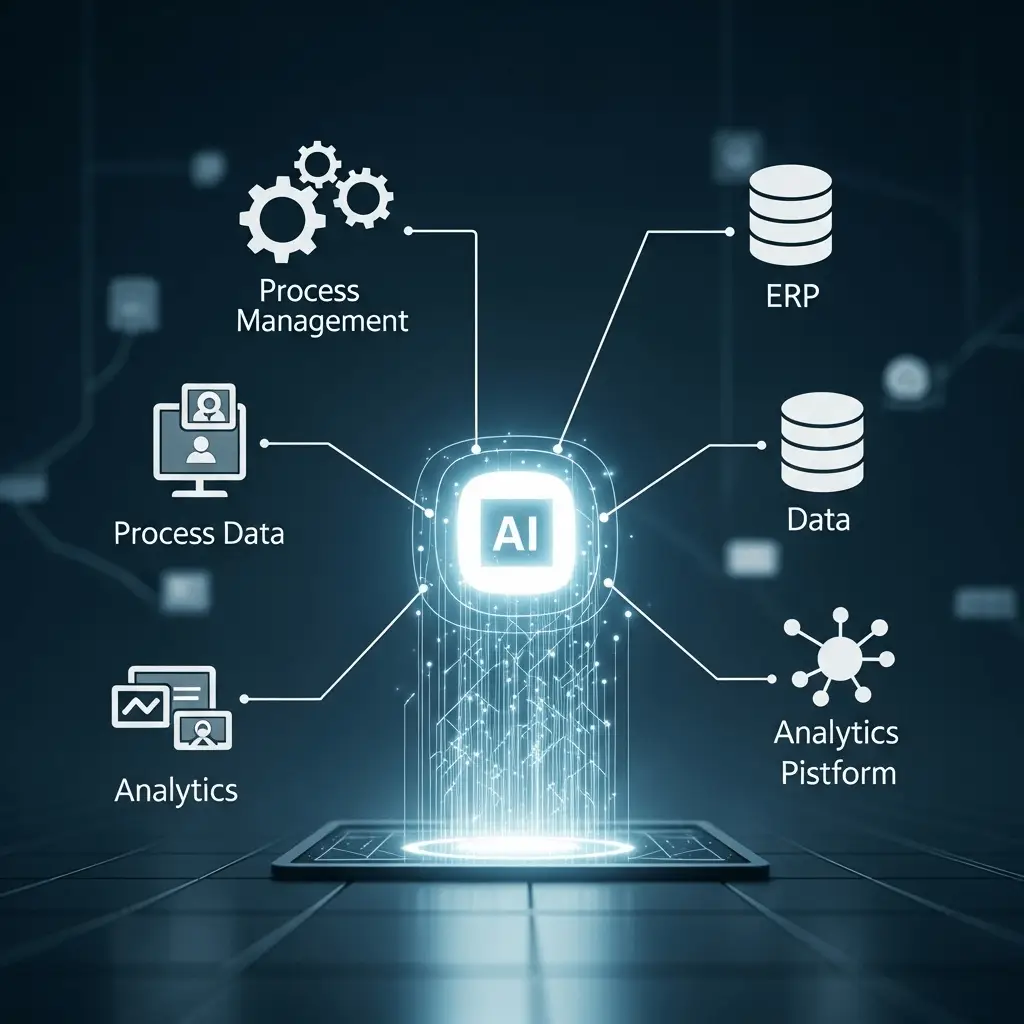
To effectively leverage AI for productivity, you must understand the underlying technology stack. The ecosystem is built on Large Language Models (LLMs) and Natural Language Processing (NLP). Core platforms like OpenAI’s GPT-4, Google’s Gemini, and Anthropic’s Claude provide the conversational engine. However, true productivity gains come from the infrastructure built around them. This includes:
- Integration Platforms (iPaaS): Tools like Zapier or Workato that connect AI chat models to your existing software suite (e.g., Slack, Salesforce, Asana) via APIs, enabling seamless workflow automation.
- Custom Knowledge Bases: Utilizing Retrieval-Augmented Generation (RAG) frameworks allows you to connect an AI model to your proprietary company data, ensuring responses are secure, relevant, and context-aware.
- Enterprise-Grade Solutions: Platforms such as Microsoft Copilot or custom-built internal tools offer enhanced security, data governance, and user management features crucial for corporate environments.
Implementation Timeline & Adoption Curve

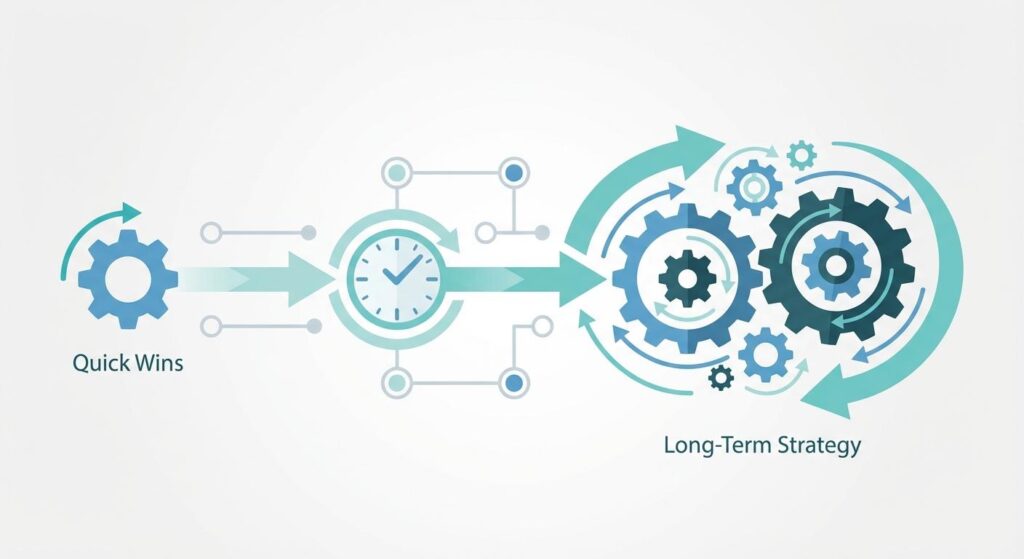
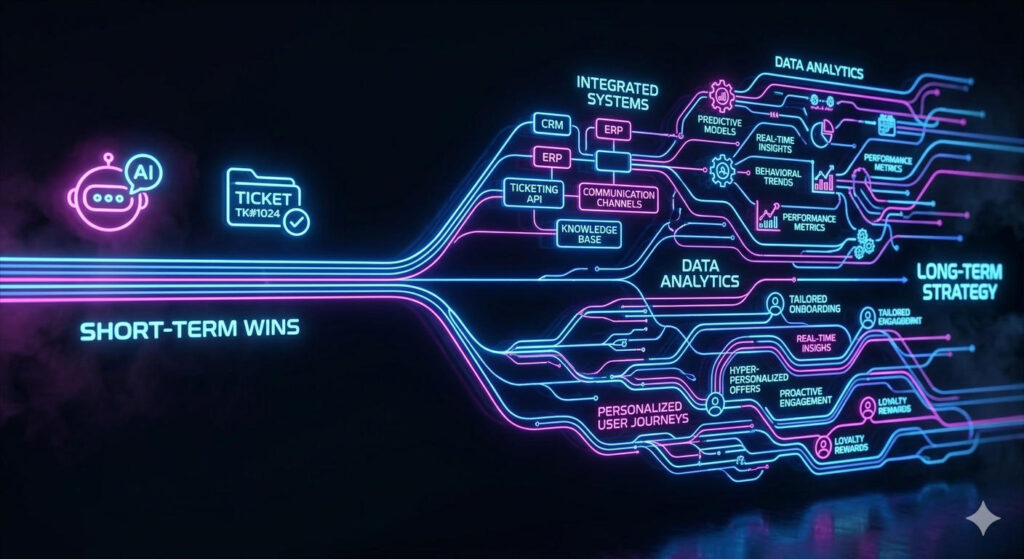
Adopting AI chat is a journey, not a single event. A phased approach balances immediate gains with long-term strategic value. The adoption curve typically follows two distinct phases:
Short-Term Quick Wins (First 1-3 Months): Focus on individual and small-team productivity. This involves using off-the-shelf AI chat interfaces for tasks like drafting emails, summarizing long documents, generating creative ideas, and debugging code. The goal here is familiarization and demonstrating immediate value with minimal technical integration.
Long-Term Scalable Strategy (6-18 Months): This phase involves deep integration. It includes developing custom AI agents that automate multi-step departmental workflows, connecting AI to internal databases for real-time data analysis, and deploying customer-facing bots trained on company knowledge. This requires dedicated resources, cross-functional collaboration, and a clear governance framework to scale effectively and securely across the organization.
Step-by-Step Implementation Framework
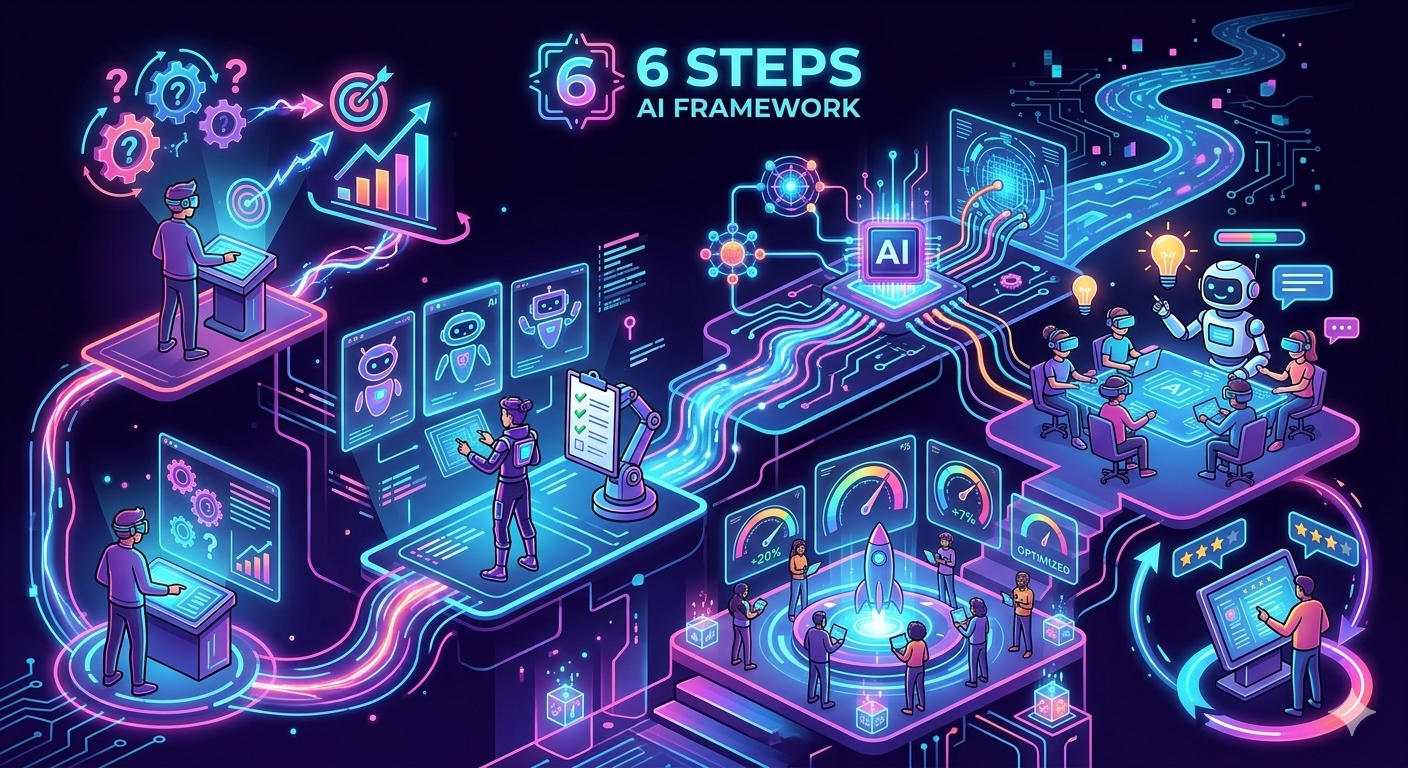
A structured framework is essential for a successful rollout that maximizes ROI and minimizes disruption. Follow these six critical steps to integrate conversational AI into your operational fabric.
- Assessment: Identify the most significant productivity bottlenecks and repetitive tasks within your teams. Survey employees to find areas where manual data entry, information retrieval, or content creation consume the most time.
- Prioritization: Score the identified bottlenecks based on potential impact (time saved, error reduction) and ease of implementation. Focus on high-impact, low-complexity use cases first.
- Preparation: Clean and organize the data sources the AI will need. Establish clear data governance and privacy guidelines to ensure secure and compliant operation.
- Alignment: Create a cross-functional team including IT, operations, and department heads. This ensures the technical implementation of the artificial intelligence chat aligns perfectly with business objectives.
- Deployment: Begin with a pilot program for a specific team. Use this phase to gather feedback, refine prompts, and validate the effectiveness of your chosen AI chatbot solution before a full-scale rollout.
- Measurement: Define key performance indicators (KPIs) from the start. Track metrics like task completion time, reduction in support tickets, or content output volume to quantify the impact and justify further investment.
Strategic Benefits
Beyond simple task automation, integrating AI chat delivers profound strategic advantages. The primary benefit is a dramatic boost in operational efficiency, as AI handles routine tasks, freeing up human talent for high-value strategic work.
This directly translates to significant cost savings and a higher ROI on your human capital. Furthermore, AI-powered tools provide unparalleled scalability; an AI assistant can support one employee or ten thousand simultaneously without a drop in performance. This creates a powerful competitive advantage, enabling your organization to innovate faster, analyze market data more deeply, and respond to customer needs with greater agility.
Advanced GEO & Semantic Optimization
In an AI-driven search world, your content ecosystem must be optimized for Generative Engine Optimization (GEO). This means structuring information so that models like Google’s Search Generative Experience (SGE) can understand and surface it. For a topic like “AI chat for productivity,” this involves creating strong entity clusters around concepts like “workflow automation,” “LLMs,” and “NLP.” Semantic layering ensures that your content connects these entities logically.
For example, explicitly defining the relationship between “ChatGPT” (the product entity) and “conversational AI” (the technology concept). A robust topical map, linking out to authoritative sources and interlinking related internal content, establishes your site’s authority. Finally, an intent-based architecture ensures you have content that serves different user needs—from informational (“What is AI chat?”) to transactional (“Best AI productivity tools”).
Mistakes to Avoid

Successful implementation requires avoiding common pitfalls. The most critical error is neglecting data security and privacy; never input sensitive or proprietary information into public AI models without proper safeguards. Another mistake is “blind trust”—assuming AI-generated output is always accurate without human verification, which can lead to factual errors.
Avoid a lack of formal training; employees need guidance on effective prompt engineering to unlock the technology’s full potential. Finally, treating AI as an isolated tool rather than an integrated part of your technology stack will severely limit its impact and scalability.
Performance Measurement & ROI Tracking
To prove the value of AI chat, you must track the right metrics. Go beyond vanity metrics and focus on tangible business outcomes. Key Performance Indicators (KPIs) should include:
- Time Saved Per Task: Measure the reduction in hours spent on specific activities like research, reporting, or drafting communications.
- Employee Adoption Rate: Track the percentage of targeted employees actively using the tool weekly.
- Task Error Reduction: Monitor the decrease in human errors for tasks now assisted or automated by AI.
- Project Turnaround Time: Quantify the acceleration of project timelines from ideation to completion.
Tracking these KPIs provides a clear, data-backed calculation of ROI and builds the business case for deeper investment.
Conclusion
The era of conversational AI is here, and its impact on productivity is undeniable. By moving beyond simple queries and adopting a structured, strategic approach, organizations can transform their operations. Implementing an artificial intelligence chat is not merely about efficiency; it’s about building a more agile, innovative, and intelligent enterprise.
A well-integrated AI chatbot serves as a force multiplier for your team’s talent. Don’t wait for the future of work to arrive—build it today with a thoughtful, long-term strategy.
FAQs
1. How long does it take for a company to see tangible productivity gains from AI chat adoption?
Initial gains from individual use cases, like content drafting, can be seen within weeks. However, significant, organization-wide productivity lifts from deeply integrated workflows typically take 6-12 months to fully realize as teams adapt and processes are re-engineered.
2. What are the most common challenges during implementation?
The primary challenges are often cultural, not technical. They include employee resistance to change, a lack of skills in prompt engineering, and ensuring data privacy and security. A strong change management and training program is crucial to overcome these hurdles.
3. How can we accurately measure the ROI of an AI chat tool that assists with creative or strategic tasks?
For creative tasks, measure proxy metrics like a reduction in time-to-first-draft, an increase in the number of concepts generated per brainstorming session, or faster project completion rates. Connect these efficiency gains to project value or revenue to calculate a tangible ROI.
4. What is the complexity of integrating AI chat with our existing proprietary software and databases?
Complexity varies. If your systems have modern APIs, integration can be straightforward using middleware platforms. However, integrating with legacy systems without APIs is significantly more complex and may require custom development and data warehousing solutions.
5. How do we ensure our AI chat strategy remains scalable and future-proof?
Build your strategy on a flexible architecture that uses APIs and avoids vendor lock-in. Focus on teaching employees the fundamental principles of interacting with AI rather than just one specific tool. Maintain a governance committee to continuously evaluate new models and platforms as the technology evolves.